• Translated
  • fr-FR
  • ja-JP
  • de-DE
  • it-IT

Fly Tying Group
Fly of the Month

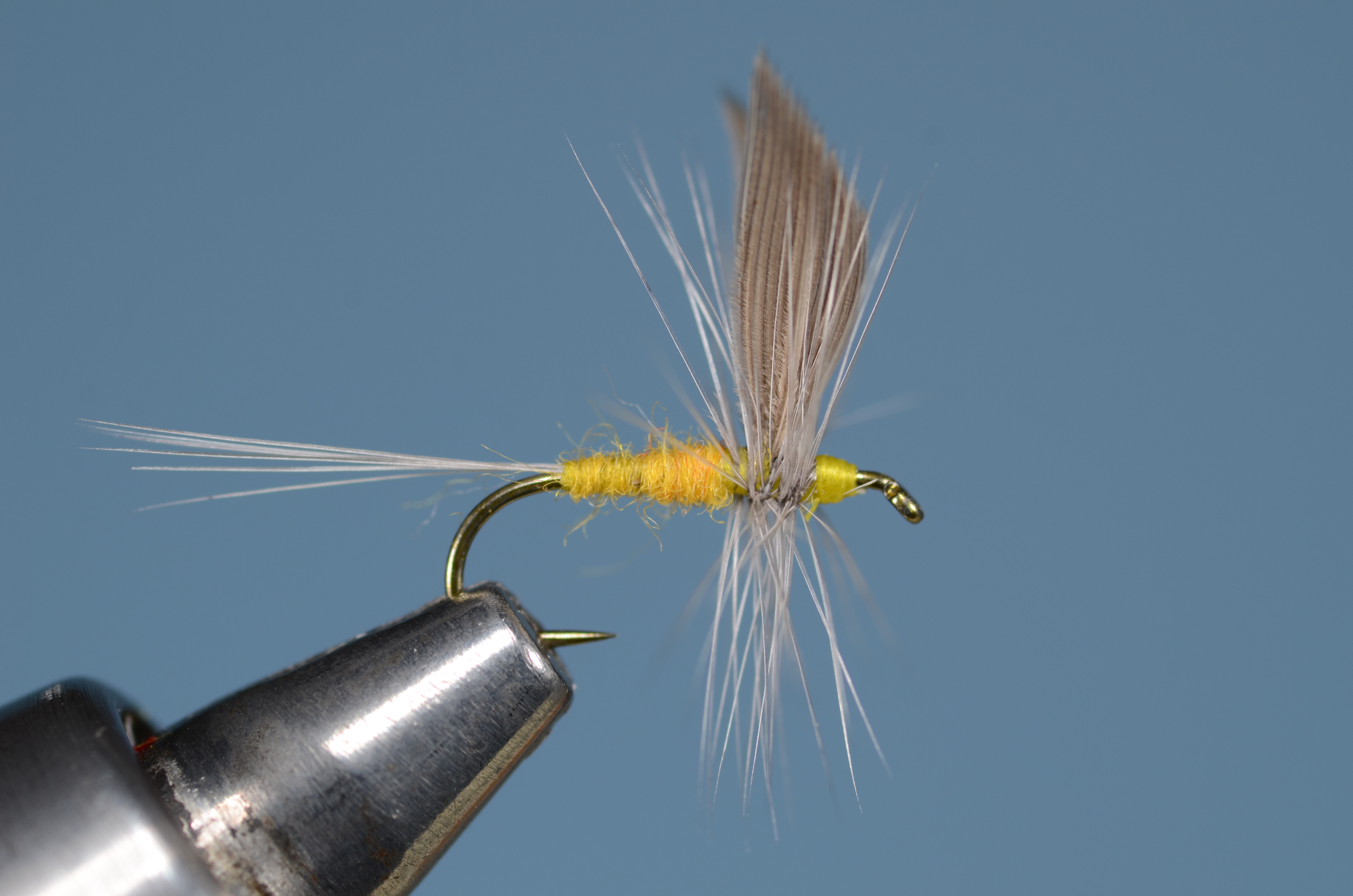
 Pale Evening Dun


Fly of the Month

We're glad you're here. You're in the right place if you want to improve your fly tying skills or learn to tie a new fly. If you find this information valuable please support our work by joining FFI and the Fly Tying Group. You may want to connect with another fly tier.  If so, use the button below to search our directory.

Find a Fly TierJoin FFI


Pale Evening Dun


Edition: June, 2026

Written by: Eric Austin

Photographed By: Eric Austin

Creator: Unknown

George C. Bainbridge’s The Fly Fisher’s Guide from 1816 is the earliest reference I’ve found

The Pale Evening Dun

The American version of this fly is based on British Pale Evening Duns dating back into the 18th century. Those were all tied with starling wings, fussy and flimsy. Tiers in the Catskills adapted the fly to the more readily available and more substantial mallard quills. Preston Jennings’ work A Book on Trout Flies does not mention the Pale Evening Dun at all, instead referring to The Little Marryat as his go-to fly for what we today call the Sulphur Hatch.

There is a great deal of bad information on the internet regarding this fly. It is not a Ray Bergman pattern as widely and erroneously reported. You can find it in Mary Orvis Marbury’s Favorite Flies from 1895, wherein she attributes the fly to Alfred Ronalds. His book, The Fly Fishers Entomology, dates to 1836. There have been countless versions of this fly over time.

I remember loving the look of a Pale Evening Dun that I bought at a general store in Morrisonville, N.Y. on the Saranac River. It had a primrose floss body. I fished that fly quite a bit and tied them too. Honestly, as much as I fished it, I do not remember ever catching a fish with it. There is an older version of this fly tied by Theodore Gordon and the Darbees that has fine flat gold tinsel wrapped as a rib around a primrose body. I have no recollection of this rib being present on the flies I fished in the ‘60s, but then again, my memory is anything but dependable these days. So add a rib if you like.

Download PDF Version


MATERIALS

Hook: TMC 100 or similar dry fly hook (Mustad 94840 or Allcock hooks for a true Catskill-style fly.)  #12-18

Thread: 8/0 or finer primrose (light yellow)

Tail: Light dun Coq de Leon or spade hackle

Wings: Mallard quill slips, right and left

Abdomen: Yellow-orange dubbing


Step 1. Start the primrose thread about an eye-length back from the eye and wrap to the start of the bend. Tie in a tail consisting of 6-8 Coq de Leon fibers. Wind the thread forward, binding down the tail on top of the hook as you go. Stop at about 30% back from the eye on the hook shank.


Step 2. The photo shows two mallard quills, a “left” on the left and a “right” on the right. If the longer fibers are on the left side of the stem, the feather is a “left.”  The longer fibers are on the right side of the stem on a “right.” Cut slips from each, around ½-¾ of the width of the shank.


Step 3. Shown here are the two slips, left and right, cut from the feathers above. I have taken these from the middle 3rd of each feather, the “sweet spot”. If you go too low on the feather the wings will be tough to mount as the slips will be flimsy. Too high on the feather and the slips will split as you mount them. The middle 3rd of the feather is what you want.


Step 4. Hold the slips back-to-back, tips flaring out. Measure them to be about hook length.


Step 5. Tie them in at the 30% mark on the shank, right where you stationed your thread. I like to use an elevated pinch, making sure that the thread is straight up and down at the tie-in point. This assures that I have mounted the wings 30-33% back from the eye exactly. This mounting point is critical to the performance of the fly on the water. Straddle the top 3rd of the shank with the slips and take 3 turns rearward.


Step 6. Adjust the wings aggressively to get them well-positioned. Trim the butts at an angle to form a taper. Wind the thread back to a point just short of the tail, binding down the angled wing butts.


Step 7. Dub the thread. You will find you cannot easily dub it all the way up to the shank, and that’s OK. Wind the undubbed section of the thread back to the tail, then wind the dubbed thread forward to just short of the wings.


Step 8. Select a hackle from a neck (not a saddle hackle). Why shouldn’t you use a saddle hackle? It is not traditional, and this is a traditional Catskill-style fly. Find one where the fibers are 1 ½-2 ½ times the gap of the hook. Prep it by stripping off fibers from the base and 3-5 extra fibers from the lower right side. This will enable you to start your hackle cleanly. Tie it in leaving a bit of the bare stem above the tie-in point. Wrap the thread forward binding down the stem.


Step 9. Bind the stem down forward in front of the wings as well. Trim the stem.


Step 10. Wind the hackle forward; bind it down forward, and trim. The number of turns of hackle you make depends on the water you fish. Always err on the side of sparseness. I see far too many over-hackled Catskill-style flies around. If I’m fishing my usual flat water I’ll use two turns of hackle behind the wings, and two in front. If fishing pocket water, 10 turns might be advisable. But the sparser you can make it and still have it float, the more fish you will catch. Wind the thread back to the hackle, whip finish forward, and trim the thread. I don’t glue the heads or use any glue whatsoever on a dry fly. The whip finish is all you need.


Editors Notes: Comments from the editor.

Please note: The demonstration you are viewing makes no claim, implied or otherwise, that the presenter or demonstrator of the fly pattern was the original creator of the fly. This is the guest tier's version of this fly and it may differ from the creator's or other versions and variations.

Please Credit FFI Website or FFI Fly Tying Group Fly of the Month with any use of the pattern. You can direct any questions or comments to FOM.FTG@Gmail.com.

Call for Fly of the Month Submissions! 

Do you know someone who you think should be featured in the Fly of the Month? If so, feel free to refer them. If you have a camera and computer, you can write a Fly of the Month article about any fly you'd like. For details contact the Fly Tying Group at FOM.FTG@Gmail.com.